Curiosity
I like trying the new thing first, on real work, and keeping what holds up. That's how agentic, spec-driven delivery went from my side experiment to how we ship new products.
Sydney, Australia
Senior Software Engineer, AI-first product engineer, full-stack TypeScript engineer, end-to-end feature owner
I'm a curious dev who puts user value first. These days I spend a lot of time working out how AI can actually help the team. I try it on real work first, then share what works.
~/new-product / delivery.flowrunning01 PRD requirements agreed with stakeholders02 Solution design + decision register03 Phase plan researched, checked04 Agent execution agent atomic commits05 Review + browser QA with AI agent every branch✓ Production 6 weeks, no major incidentsapproach
Full-stack product engineer building web products with TypeScript, Vue/Nuxt, React, Node.js and GraphQL.
I like trying the new thing first, on real work, and keeping what holds up. That's how agentic, spec-driven delivery went from my side experiment to how we ship new products.
Fancy tech means nothing if users don't get value from it. I work out the requirements with stakeholders, ship, then check the analytics to see if it actually worked.
I proved AI tools and workflows on real work first, then rolled them out to about 20 engineers with guides, security practices, shared tooling and a few talks.
leadership
Most of my best work starts with a chat. I talk to stakeholders early about what users really need, bring the team along on new ways of working with AI, and check the numbers after we ship.
Stakeholders
Before any code, I sit down with stakeholders and other teams to work out what problem we're solving, for whom, and how we'll know it worked. Then I write it up as a solution design everyone can poke holes in, so the trade-offs stay out in the open.
AI adoption
I try new AI tools and workflows on my own work first. If they hold up, I bring the team along with guides on agentic coding, AI-first and pair-prompting proposals, agent security practices, shared tooling and talks. People pick it up when they see it work on their own problems. That's how it spread across a team of about 20.
End value
Shipping isn't the end. I set up A/B experiments, look at the analytics after launch and share what we learned with stakeholders. Doing this lifted a company north-star metric from 22% to 37%.
Agentic delivery
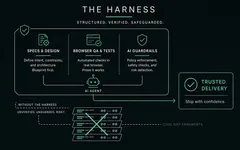
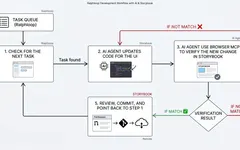
Requirements turn into a solution design, the design turns into a checked plan, and AI agents build it with automated code review and browser QA on every branch. I still review everything. This took a new product from an empty folder to production in 6 weeks.
toolbox
writing
off-the-clock