
I gave my AI agent a Dory memory
Every time I wrote a solution design, I somehow managed to miss something important that I didn't even know existed. Maybe it was a sneaky dependency, some experiment running in the shadows, or a lesson from an incident that everyone forgot to mention. You know, the usual suspects.
So, I decided to build my own AI memory and named it Dory (yes, like the forgetful fish 🐟). It's basically a graph database with vector search that syncs with your tools and spits out context answers in about 2 seconds. People and blind spots included.
I've been cooking on the AI agent memory problem for a while now. Got inspired by chats with my mates here at Safewill, and I ended up building something that actually helps me day to day.
Missing context is painfully expensive#
When I'm writing a solution design (SD), it's so easy to miss stuff. Another team's initiative depends on the same code I'm changing. A feature flag is still running a 50/50 experiment. Someone already tried this approach and it didn't work.
The unknown unknowns look like this:
- A dependency you didn't know existed breaks in prod.
- Your SD gets sent back with "did you check with Team X?"
- Halfway through implementation, you find out someone already solved this.
- You deploy and accidentally break another team's running experiment.
And the real cost:
- Rewriting the entire SD after discovering a missed flow.
- Duplicate work across teams who didn't know about each other.
- Incident postmortems that say "we didn't know X was connected to Y".
- Knowledge locked in people's heads, gone when they leave.
First attempt: let AI search Confluence#
Claude Code has an Atlassian integration. So I asked it: "What do I need to know before working on the onboarding redesign?"
What actually happened:
- Search Confluence for "onboarding" pages.
- Read each page, pull out keywords.
- Search again with those keywords.
- Read those pages, find more references...
- Hit the Atlassian rate limit. Start over.
And the worst part? After 15-20 API calls and 90 seconds of waiting, I got 163K characters of raw JSON. No relationships between tickets. No people mapping. Lessons from incidents? They're in Slack, not Confluence.
And next sprint, when I touch a similar area? The whole loop starts again.
What if AI had its own memory?#
Instead of searching Confluence every single time, what if I built a persistent memory that knows everything (projects, people, relationships, past decisions, lessons learned) and can answer questions instantly?
That's Dory. The whole point is to remember things, which is the joke.
- A graph, not flat files. Instead of markdown docs, Dory stores knowledge as nodes and relationships. "Alice engineers on Project X which depends on Project Y" is a first-class thing, not text buried in a doc.
- Syncs from your tools. It pulls from Jira, Confluence and Slack automatically. Projects, solution designs, who's working on what, incidents, lessons, all connected in one graph.
- Just ask it questions. Natural language in, structured answers out. Not a JSON dump. Ranked results with relationships, people and blind spots in under 2 seconds.
I iterated 5 times in a day#
I didn't plan everything upfront. Built the simplest thing, ran a benchmark, found the gaps, fixed them. Repeat.
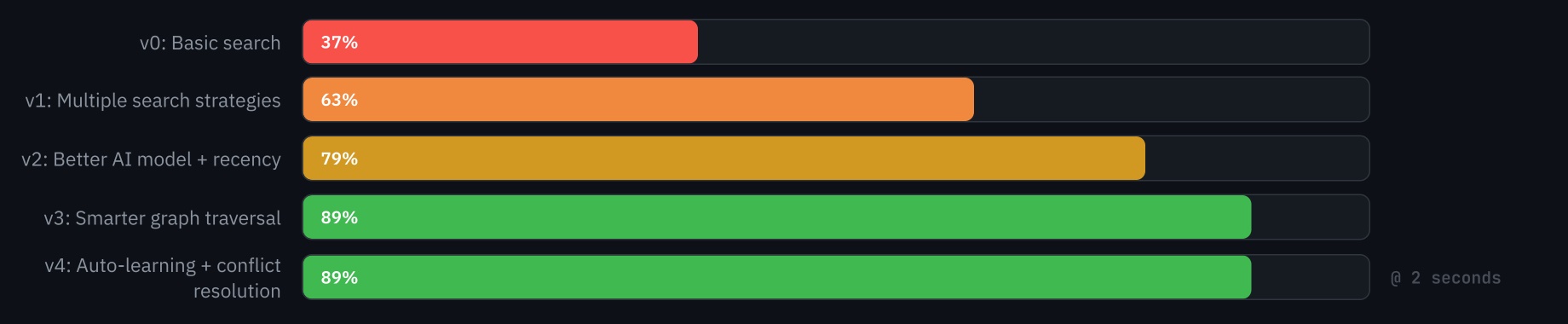
The biggest single win? Breaking each question into sub-questions. Instead of one search for "onboarding redesign lean solution design", it also searches "onboarding", "redesign" and "lean" separately. That alone jumped accuracy from 37% to 63%. Sometimes the simplest idea is the best one.
Same question, two very different experiences#
"I'm starting the onboarding redesign. What projects, people and risks should I know about?"
| Dory: 1 question, 2 seconds | Confluence: 15+ API calls, 90 seconds | |
|---|---|---|
| Related projects | 10 found, with tech details | Titles only, no details |
| People to talk to | 8 people, with expertise | Just an "assignee" field |
| Dependencies | Shown as graph links | Not captured at all |
| Blind spots | 10+ surfaced | None surfaced |
| Past lessons | From incidents + retros | Locked in Slack threads |
| Active experiments | Flagged automatically | Have to check manually |
So what does it actually change? Context gathering is 45 times faster (2 seconds vs 90 seconds), it catches 10+ blind spots I'd have missed completely, uses about 90% fewer tokens, and the running cost is $0 because everything runs on my laptop.
Before: 15-30 minutes searching Jira, reading Confluence, checking Slack, and manually piecing together who worked on what, what depends on what, and what went wrong last time.
After: one question, two seconds, full context, including relationships and blind spots I wouldn't have found on my own.
Dory learns as you work#
It's not a static snapshot. Dory syncs from your tools and learns from conversations. When something comes up in a standup or a PR review, you feed it in and it remembers.
Auto-extraction. Paste raw text like meeting notes, Slack threads or standup updates. A local AI model pulls out the entities and relationships, matches them to what it already knows, and saves them.
"Mike said PROJ-821 is moving to Elaboration"
→ Updates status. Links Mike as engineer.
Conflict resolution. When new info contradicts what's stored, like a status change or a role change, Dory catches it and replaces the outdated fact. The graph stays current without manual cleanup.
Old: "PROJ-821 is in Backlog"
→ Replaced: "moved to Elaboration"
This isn't just an engineering thing#
The unknown unknowns problem shows up everywhere in an org. If a graph memory helps engineers write better SDs, it can help others too.
- Product managers: "What experiments are running in checkout right now?" "Which initiatives touch partner onboarding?" Instant context before planning sprints or writing PRDs.
- New joiners: "Who owns the executor flow?" "What happened with the last redesign?" Institutional knowledge from day one, not locked in someone's head.
- Leadership: "What's everything touching the onboarding funnel right now?" Cross-team visibility without scheduling alignment meetings.
The idea is simple: a shared, structured, searchable memory of everything your org knows. Not buried in Confluence pages nobody reads, but connected as a graph that AI can navigate.
Runs entirely on a laptop#
No cloud services, no API keys, no subscription. A graph database, a Python server and a local AI model. 500+ knowledge nodes, 800+ relationships, 89% retrieval accuracy, 2 seconds average response.
I put Dory head-to-head with Neo4j's official GraphRAG library, same database, same AI model, same query. Dory scored 89%, GraphRAG only managed 58%. I tried mem0 and other stuffs too, but none of them could beat Dory. Turns out the retrieval pipeline is the real MVP here, way more than which library you use.
Built with Neo4j, Python, Ollama and Claude Code. The whole thing took a day.
What I took away from this#
- The best AI tool is the one built for your context. Even well-built generic libraries can't compete with something made for your team's data, naming conventions and way of working. Domain knowledge is the moat.
- Iterate with benchmarks, not vibes. Every change got benchmarked against the same query. Some "obvious" improvements barely moved the needle. The biggest win was the simplest: asking the question multiple ways.
- Memory is the missing piece in AI tools. LLMs are great at reasoning and terrible at remembering. A structured knowledge graph fills that gap: persistent, queryable memory that knows about relationships and grows over time.
- You can build this in a day. This isn't a 6-month platform play. It's a Python server, a graph DB and a local AI model. Built, iterated and benchmarked before dinner. The hard part isn't the tech, it's knowing what to put in the graph.
There are a lot of fish in the sea (a bunch of AI memory tools), but for my specific use case, Dory is MY fish!
If you want the pretty charts, the full slides are here (PDF).